


Daniel Azoulay
Architectural photography has fundamentally reshaped how we perceive and engage with design. As images have become increasingly ubiquitous, the influence of architecture on culture and society is now felt far beyond physical spaces. In the last thirty years, we have shifted from encountering buildings solely through direct experience or printed representation to understanding architecture through digital media, renderings, and photography. This transformation has opened new opportunities for architectural photographers—inviting them to reveal a designer's vision through light, form, and the nuances of structure.
By translating three-dimensional space into a two-dimensional image, architectural photographers must draw upon their knowledge of both the built environment and the visual mediums through which their work is communicated. Their compositions are guided by narrative and intention: buildings become storytellers. Photographers balance accurate representation with artistic interpretation, illustrating not only what a structure is, but how it participates in the larger context of the city. Through their images, architecture is understood from multiple vantage points—capturing moments, materials, and the human presence that shapes our experience of design.
Based in Miami, Daniel Azoulay bridges both commercial and artistic practices in his work. He approaches architecture and infrastructure as a way to make sense of the world—fascinated by how cities function and how their components interconnect. His photographs can be read as a visual guide to Miami: revealing the city from above as a network of systems and from the ground as a collection of everyday monuments. From the Adrienne Arsht Center to the Port of Miami Tunnel, The Perez Art Museum, Frost Science Museum, The Children’s Museum, The Brickell City Center, The Connecting Miami Project I-395/SR, 836/I-95, to Miami’s skyline of over 30 soaring towers—each place carries its own story through photographs.
Together, they form a powerful portrait of a city constantly evolving.
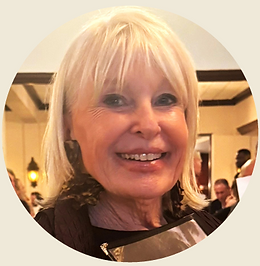
Maureen Collins
Maureen Collins has been a resident of Fisher Island for 37 years, and is an amateur photographer.
Many years ago, on a visit to St Mark’s Square, Venice, I photographed a couple in an embrace and framed it. It was my first framed photo that wasn’t of family. I showed it at a small show at the Gibson Island Club. The time was Valentine’s Day and amazingly, some people wanted to buy it!
Anyone can take a picture. Take a photo of something that may be a few seconds in time never to be seen like that again. Or take a photo that documents a certain moment in history.
The world is full of amazing beautiful people and wondrous places. And I just “click” .
Post Script: Also a thank you to Lorraine Letendre who had confidence in my abilities and encouraged me.

Nancy Engels
My paintings are quiet meditations on lineage, memory, and devotion—expressions of who I am, and perhaps, who I was always meant to be.
In my early fifties, having closed a deeply fulfilling chapter as a teacher of literature and the humanities, I found myself yearning for a new language of expression—one beyond words. By chance, a friend invited me to a painting class. From the moment I touched brush to canvas, I felt a current of recognition—as if something ancient had awakened within me.
Years later, I discovered an old photograph of my grandfather, who I never met, standing at his easel painting the portrait of an elegant woman. That image felt like a benediction—proof that art had always been woven into my family’s fabric, waiting to be reborn in me.
For me, painting is a dialogue between patience and revelation. At first, I paint the soft outline of form, and then—layer after layer—the figure begins to breathe. Like studying Shakespeare or rereading the poetry of Dickinson, each encounter reveals something new, something previously unseen. My process is one of devotion: of returning, refining, rediscovering. I am endlessly fascinated by the way light caresses a pearl, or how fabric holds the memory of touch. Each brushstroke is an act of gratitude—for the gift of vision, of time, of creation itself.
In painting, I have found not only a second career but a second life—a life guided by beauty, discipline, and an abiding sense of wonder.


Alan Heldman
Alan Heldman first learned to draw from his grandfather Max Heldman, who came from Kiev to Birmingham, Alabama, as a boy in 1907, and who studied at the Art Institute of Chicago and the Art Students League of NY to become a successful commercial illustrator and artist. When Max Heldman was commissioned to illustrate heart surgery diagrams for the pioneering surgeon Dr. John Kirklin in Birmingham, young Alan was imprinted on those blue and red hearts (watercolor mixing to purple in cases of septal defects!) Alan went on to become a pioneer himself of interventional and structural cardiology at Johns Hopkins and later at the University of Miami.
Watercolor practice with his friends and their wonderful instructor, Will McGaul, has brought Dr. Heldman great joy.


Marian Hymen
I am not a professional photographer, ornithologist, or writer. So why photograph birds and why write about them? The answer lies in the question, “What kind of bird is that?”
The new Fisher Island Aviary opened in February 2010 and quickly became a popular destination for residents and their children, grandchildren, and guests. Visitors would often ask, “What kind of bird is that?” To help answer those questions, I decided to photograph the parrots of the Aviary and pair the images with brief descriptions of each bird. The result was a small book aptly titled, “The Fisher Island Aviary,” which I gave to anyone interested in learning more about the birds.
I did not realize it at the time, but my journey had just begun.
I began to appreciate Fisher Island as a stunning paradise rich in wonderous wildlife, much of it being beautiful birds. If I could photo document the nonnative parrots, why not photo document as many native avian species as I could find on Fisher Island?
Armed with a new camera, I set out to do just that. To date, I have photographed approximately 130 species – most of them avian – and have written three additional books.
Along the way, I wanted to know more. I wanted to really understand the subjects captured in the camera’s lens. I began reading about avian anatomy, physiology, behavior, and INTELLIGENCE, and I began networking with folks in the wildlife rehabilitation and conservation communities. I developed an awareness of the intrinsic challenges and human imposed threats animals face. Their industriousness, instinct, ingenuity, and tireless efforts to prevail etched a place of deep appreciation for them in my heart.
It is a privilege to be able to photograph these remarkable creatures. My hope is that my photographic journey inspires a collective state of mind to nurture avian well-being. For with a little help from us, we can ensure that these species thrive for generations to come.

Nick Moss
Nick Moss, born in Michigan in 1985, developed an early connection to steel through farm work and welding, eventually refining his skills in industrial fabrication before turning to art. By 2014, he began forging his own artistic path, using steel as his primary medium. Treating metal as a “canvas” and tools like torches and welding guns as brushes, Moss creates richly textured, abstract works that embrace the unpredictability of heat, movement, and material.
Working entirely by hand from his New York studios, Moss blends minimalism, abstraction, and figuration through techniques involving patina, flame, and soot. His work ranges from geometric compositions and figurative steel nudes to symbolic motifs like emojis and flowers, the latter inspired by emotional expression and the historical “language of flowers.” His process is deeply personal and experimental, with each piece shaped by intuition, heat, and the physical dialogue between artist and material.
Moss has gained recognition through exhibitions in New York, Aspen, and Dubai, and his work continues to resonate with both critics and collectors. A major milestone came in 2024, when one of his pieces achieved a record sale at Sotheby’s Contemporary Discoveries auction in London, underscoring his growing presence in the contemporary art market and validating his innovative steel-based practice.
His current American flag series exhibition is now on display in Palm Beach on Worth Ave at the world renowned gallery of Ross + Co Arcature Fine Art: 238 Worth Ave, Palm Beach, now until May 2.


Linda Paresky
Linda Paresky has been a Fisher Island resident since 1997. She and her husband, David, lived in the Boston area where they founded a travel company and raised 3 children. After selling and transitioning the company to American Express, they moved to Florida, where 2 adult children were already residing.
Golf and Pilates were followed more recently by an interest in watercolor classes by William McGaul.
Works exhibited here are simply exercises in techniques and untitled.


Nigel Ross
Nigel Ross was born and educated in London and holds a law degree from the London School of Economics. He has spent his career in commercial real estate, primarily in the United Kingdom, while also expanding his work to New Zealand over the past two decades.
A Fisher Island member since 2011, Nigel became a U.S. resident in 2018. He and his family split their time between the U.S. and the U.K., where their two sons reside—one in Delray Beach and the other in England—along with their six grandchildren.
Beyond his professional career, Nigel has been an avid collector of Vesta Cases (also known as match safes) for more than 35 years and was a founding member of the International Match Safe Association, reflecting his longstanding passion for the history and craftsmanship of these unique collectibles.


